Suggestions for Making an Herb Garden- History of Herbs Gardens
A simple, neat herb garden is one that is about four metres square, well- drained, and situated in a sunny position. The bed should be prepared by digging in plenty of leaf mould and mushroom or household compost. Add a small amount of coarse river sand if the soil is heavy.
If on the other hand the soil is sandy, and herb likes to grow in this type of soil for drainage, it may be built up with compost for nourishment. Beach sand is not suitable as it contains too much salt, which will kill the plants; river sand bought commercially contains no salt.
Herbs make excellent rockery plants. We once planned a rockery herb garden for friends. It was on slopping ground and herbs were planted on terraces where pathways on each level led down by steps to the small, grassy lawn below.
There are more elaborate herb gardens that one can make, such as modified mediaeval cloister gardens, and Tudor and Elizabethan gardens reminiscent of the formal ancient Eastern gardens. “Knot” gardens became popular in Tudor times and they were delineated by clipped, dwarf box hedges in complicated patterns. Fragrant, culinary, and medicinal herbs and favourite flowers were planted within the knot’s miniature hedges. Scented lavender or rosemary are excellent for surrounding a garden and may be shaped and pruned after flowering. These kinds of gardens are interesting to plant and are relatively inexpensive to make.
Stone or brick walls around a herb garden cost more, but they give a special, nostalgic feeling of bygone days as you enter them. A sunken garden can be included in a more elaborate herbs garden. The sides hold back the earth with paving stones, and between them, in spaces allowed for this, are planted various ornamental perfumed thymes, prostrate rosemary and small, sprawling, old- fashioned perennials, which all help to blind the soil. Low – growing herbs are planted along stone or brick pathways bisecting conventional geometric beds filled with taller herbs.
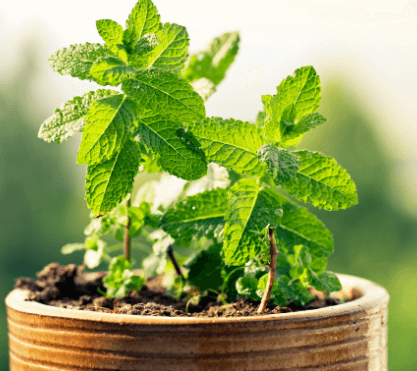
However small, a herb garden is a unique place with a definite feeling of mystique. It needs an interesting focal point like a sundial, a suitable statue, a bird- bath, or a “herb seat”. This is made of brick of stone, filled with earth and covered with a matting, scented thyme or starry – flowered lawn chamomile. Paths of mown grass, paving stones, pebbles or pine bark make for easier access when picking. Small plants for edging are chives, chervil, lemon thyme, savory, upland cress, bush basil and curled parsley. Behind them, for graduated height, can be grown borage, lemon balm, sweet basil, bergamot, marjoram, French sorrel, oregano, Florence fennel, tarragon, coriander and dill. Some taller herbs for background planning are angelica, lovage, garlic, upright rosemary, Italian parsley and chicory. Bay trees grow very big if allowed to, and they can be planted on each side of the entrance to the garden; they can always be clipped and shaped to keep them compact. Elder trees and lemon verbena trees may be placed as lemon verbena trees may be placed as sheltering and protective guardians just outside the herb garden.
Another way to make a pretty and pleasant herb garden is to buy an old cart wheel. Remove every second spoke and paint it white. Lay it on prepared ground and plant herbs between the spokes radiating from the centre, choosing low- growing herbs that will not sprawl all over the wheel. A similar idea is to use an old ladder, cut in half, painted white, and laid on the ground with a pathway along the centre. Herbs can be planted between the rungs.
If a herb garden as such is not important to you, and yet you would like to have a few of your favourites, grow them amongst other plants, Gardens edges with curled parsley, or chives, are useful and attractive at the same time. Taller herbs amongst other flowers add their share of fragrance and foliage interest. The larger herbs can be grown amongst the shrubs at can be grown amongst the shrubs at the back of the garden.
Ingenuity plays a large part in making a herb garden and imaginations can produce some wonderful new ideas. A garden of herbs is extremely useful in many ways, as well as being full of fragrance and delicious flavours, and is always a pleasure to look at. It is worth remembering not to overfeed herbs, this makes them soft and lush with little flavor. (Parsley and chives are exceptions.) Overwatering, or a place which becomes waterlogged in heavy rain, is disastrous, although watercress is one herb that likes these conditions.